
Document overview
The context of the present technical development is the continuous increase of CO₂ concentration in the atmosphere and the perturbation of global Earth carbon cycle.
The land sink study is definitively the main interest of the development of CO₂ lidar measurements ultimately from space. One must understand here that CO₂ surface flux and not only concentration is the final product the scientific community is interested in.
In addition, there is a need of ground-based, airborne and space-borne observations that enable to address the patterns and the quantification of CO₂ sources and sinks at local to regional scales (100 m to 100 km) and CO₂ lidar is a well-suited instrument to do so.
To characterize carbon sources and sinks at a regional scale, to know and understand the temporal distribution and cause of variations for individual ecosystems to political units and continents, two approaches are currently investigated: downscaling from ground-based in-situ network CO₂ concentration measurements using a transport model (top-down method) or up scaling from local direct flux measurements using biophysical models and remotely sensed information about vegetation activity (bottom-up method).
In the top-down approach (Figure 1), the atmosphere acts as a large-scale integrator, whose atmospheric CO₂ variations reflect where CO₂ has been added to or removed from the atmosphere.
The interpretation of these variations is not entirely straightforward, but by using information about transport and mixing from atmospheric transport models, one can, in principle, determine where the source sand sinks for carbon dioxide are, how large they are, and how they have varied through time.
This « inverse method » is the one that is concerned in the framework of a CO₂ space lidar mission like A-SCOPE [ASCOPE 2007] and ACDL [Fan 2024].
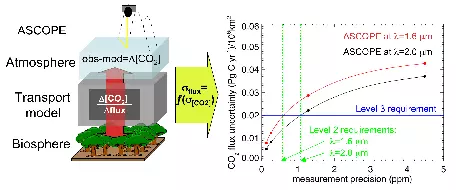
Figure 1. Schematic outline of top-down approach to translate observation requirements on the accuracy of derived fluxes into precision requirements for XCO2. The left side represents the inversion methodology from which a relationship is obtained between XCO2 and flux estimates uncertainties. This relationship is plotted on the right-hand side for two wavelengths considered in A-SCOPE. The inferred requirements refer to the threshold IPDA precision for a uniform weighting function (measurement at 1.6 μm) and for a weighting function that scales about nearly with pressure (measurement at 2 μm). [ASCOPE 2007].